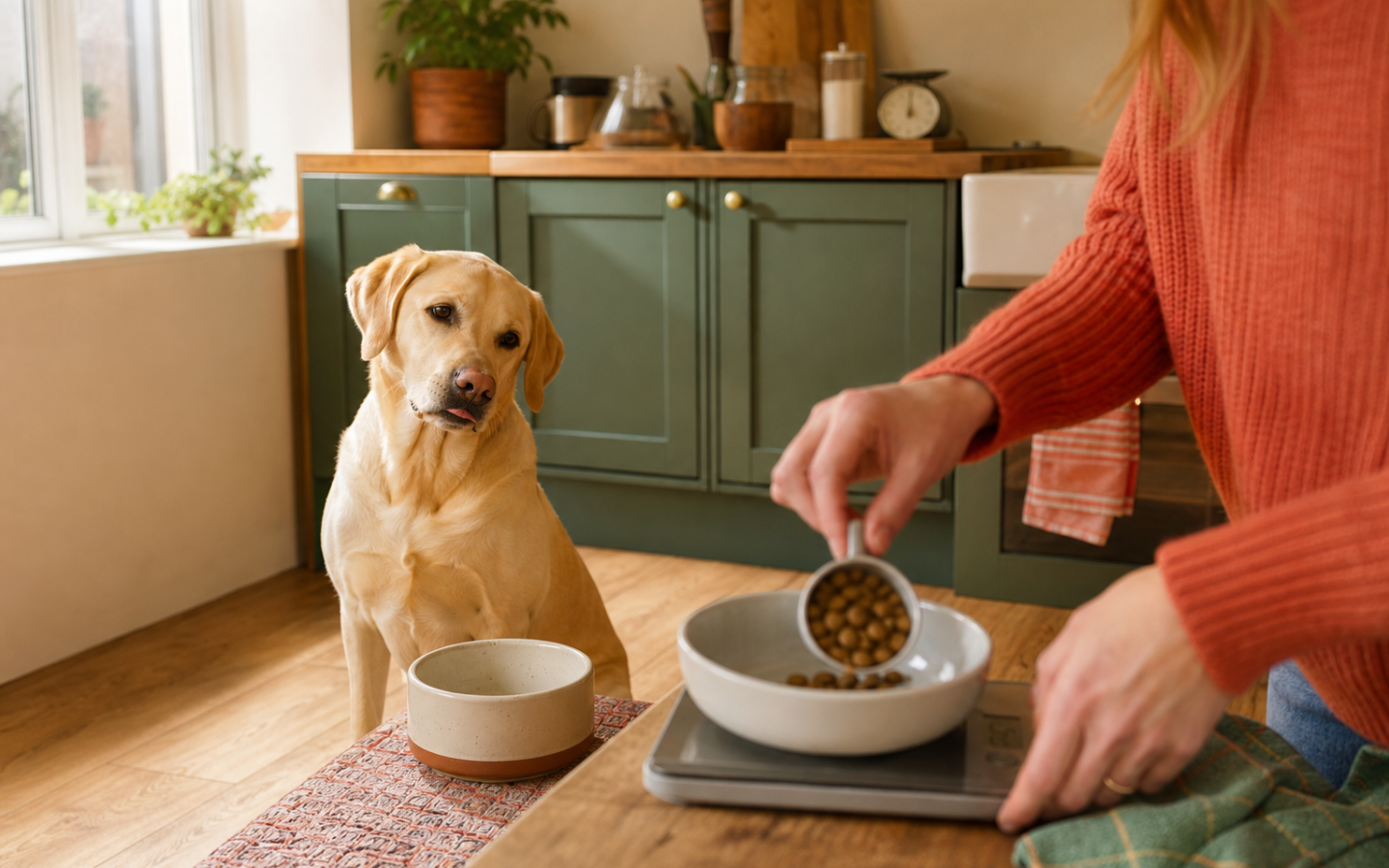
The number printed on a feeding chart is a starting point, not a verdict. A more useful plan begins with an energy estimate, checks the calories in everything that enters the bowl, and then adjusts according to your dog’s weight trend and body condition.
The short answer
A common veterinary starting point is the resting energy requirement, or RER:
RER = 70 × body weight in kilograms0.75
RER estimates the energy used for essential body functions at rest. It is not usually the final feeding target. To estimate maintenance energy requirement (MER), RER is multiplied by a life-stage factor. AAHA lists a general range of 1.4–1.6 × RER for neutered adult dogs and 1.6–1.8 × RER for intact adults. Dogs that are inactive or prone to obesity may need a lower starting factor. Puppies, working dogs, pregnant dogs and nursing dogs require a different approach.
A worked example for a 10 kg adult dog
For a healthy 10 kg neutered adult dog:
- Calculate RER: 70 × 100.75 ≈ 394 kcal/day.
- Apply an adult-neutered factor of 1.6: 394 × 1.6 ≈ 630 kcal/day.
- Treat 630 kcal as an initial estimate, not a permanent prescription.
If the same dog is sedentary, gains weight easily, or is already above an ideal body condition, the appropriate target may be lower. A very active dog may need more. When weight loss is the goal, use the dog’s ideal weight and work with a veterinarian rather than simply cutting the current bowl by an arbitrary percentage.
Calculate your dog’s starting point →
Why cups and grams are not calories
A cup measures volume. A gram measures weight. Neither tells you how much energy the food provides until you know its calorie density. Two foods can occupy the same cup but contain very different numbers of calories.
Look for a statement such as kcal per cup, kcal per can, or kcal per kilogram on the package. If the label gives kcal/kg, convert it to kcal/g by dividing by 1,000. Then:
Daily food calories = grams fed × kcal per gram
For example, a dry food containing 3,800 kcal/kg provides 3.8 kcal/g. A 140 g daily portion provides about 532 kcal. Treats, toppers, chews, table scraps and fresh-food additions belong in the same daily total.
The 10% rule for treats and extras
AAHA advises that treats—including table scraps—should generally make up no more than 10% of total daily calories. This helps protect the nutritional balance supplied by a complete and balanced main diet.
For a dog starting at 630 kcal/day, 10% is 63 kcal. That allowance can disappear quickly: a dental chew, several training treats and a spoonful of peanut butter may collectively exceed it. Count extras first, then decide what remains for the main food.
Body condition is the feedback loop
A calculator cannot see your dog. The practical feedback comes from repeated measurements:
- Body weight: use the same scale when possible and compare the trend, not a single reading.
- Body condition score: ribs should be easy to feel under a light fat covering, with a visible waist from above and an abdominal tuck from the side.
- Muscle condition: watch for loss around the spine, shoulders, skull and hips, especially in senior dogs.
- Appetite, stool and energy: record meaningful changes rather than reacting to one unusual day.
If weight is moving in the wrong direction for two to four weeks, reassess the recorded intake and discuss a measured adjustment with your veterinary team. Senior dogs may need fewer maintenance calories over time, but unexplained weight or muscle loss deserves veterinary attention rather than an automatic increase in food.
Does breed change the calculation?
Breed is useful context, but it does not replace the energy equation or body-condition check. A Labrador that gains weight easily, a lean young sighthound and a small dog with short bursts of activity may respond differently even at similar body weights. Breed tendencies matter most when they help you choose a sensible starting factor and decide how closely to monitor the result.
That is why PawKnow asks for species, life stage, activity and breed context, then presents the answer as an estimate. The number becomes useful only when it is connected to the real dog in front of you.
When not to rely on an online estimate
Ask a veterinarian or a board-certified veterinary nutrition specialist for an individualized plan if your dog is growing, pregnant, nursing, significantly underweight or overweight, has a chronic illness, takes medication that affects appetite or metabolism, or eats a fully home-prepared diet. Rapid weight change, persistent vomiting or diarrhea, marked thirst, lethargy or loss of muscle also requires veterinary assessment.
A five-minute weekly routine
- Write down the calorie density of the main food.
- Weigh the actual daily portion instead of relying only on a scoop.
- Count treats, chews, toppers and fresh additions.
- Compare the total with the estimated daily target.
- Track weight and body condition, then adjust gradually with professional guidance when needed.
Start with an estimate you can actually check
Use the free PawKnow calculator to estimate daily energy, account for the calories already supplied by commercial food, and plan a supplemental fresh-food portion.
Open the free dog calorie calculator → Explore the 21-Day Feeding Reset →
开始交流
分享经验或提出有价值的问题;医疗急症请直接联系兽医。