If you want half your pet’s main-food calories to come from wet food, putting equal weights of wet and dry food in the bowl usually will not achieve it. You need the calorie density of each product and an agreed daily calorie target.
Check suitability before doing the maths
The two main foods should be suitable for the pet and their life stage. AAFCO explains that a nutritional adequacy statement identifies whether a food is intended as a complete and balanced sole diet; snacks and supplements often are not. The statement matters more than a general “natural” or “premium” description. AAFCO: reading pet-food labels.
For a prescribed diet, growth, illness or a weight-management plan, agree the foods and daily target with your veterinary team. Mixing two foods is not a way to repair an unbalanced homemade recipe.
A 400-kcal example
The following numbers are hypothetical and are not a calorie prescription for a particular animal. Suppose the agreed daily total is 400 kcal, including 40 kcal of treats. That leaves 360 kcal for the main foods. If half those main-food calories should come from each food, allocate 180 kcal to each.
| Food | Label | Calculation | Daily weight |
|---|---|---|---|
| Wet food | 100 kcal per 100 g | 180 ÷ 1 kcal/g | 180 g |
| Dry food | 400 kcal per 100 g | 180 ÷ 4 kcal/g | 45 g |
The result is 225 g of main food, not two equal weights. Check the total: 180 g × 1 + 45 g × 4 + 40 kcal of treats = 400 kcal. If you serve two equal meals, each contains 90 g wet food and 22.5 g dry food, with the treats accounted for separately.
Convert the label once
For kcal/kg, divide by 1,000 to get kcal/g. For kcal/100 g, divide by 100. For kcal per can, divide by the can’s net weight in grams. If the label uses a cup, you also need the corresponding grams per cup for that exact product; do not assume all kibble has the same weight per cup.
Keep the plan usable
Write the exact food names and daily gram amounts where everyone who feeds the pet can see them. Recalculate when a product or its energy density changes. Observe body weight and condition over time rather than treating a single formula result as a permanent ration.
Use the worked examples and printable record below to plan a commercial wet-and-dry mix. The PawKnow Kitchen prescribed-plan organiser divides one complete diet into meals and days using the food and daily amount already agreed with your veterinary team. Enter either the daily grams or the daily calorie target plus that diet’s labelled energy density. It does not choose a treatment or calculate a wet-and-dry mixing ratio. For suitable healthy adult dogs, the separate cooked-food guide offers ingredient selection and preparation amounts from a public manufacturer guide, with its specified supplements. It does not certify a freely assembled recipe as nutritionally complete.
Method and sources checked September 25, 2026. Example values are invented for arithmetic demonstration. Image is an AI-generated editorial illustration.
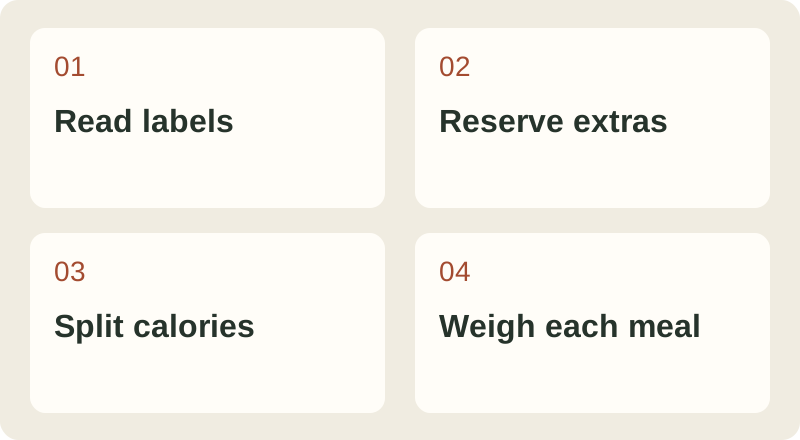
Turn the calculation into tomorrow’s feeding note
Here is a second version of the same invented 400-kcal day. Keep the 40-kcal allowance for extras, but allocate 60% of the remaining 360 kcal to wet food and 40% to dry food. That makes 216 kcal wet and 144 kcal dry. With the same labels as above, the amounts are 216 g wet food and 36 g dry food per day. Across two equal meals, serve 108 g wet and 18 g dry per meal. The check is 216 × 1 + 36 × 4 + 40 = 400 kcal. These are arithmetic examples, not a recommended ratio or calorie target.
- Photograph the labels. Record the exact product, calorie unit, net pack weight and date. Do not reuse another flavour’s energy value.
- Reserve actual extras. Subtract the agreed total for suitable treats and toppers before splitting main-food calories. An allowance is not an amount you must use.
- Write daily and per-meal grams. Include who feeds each meal, and keep planned and actually eaten amounts separate.
- Recheck when the food changes. A new product with 1.2 kcal/g would need 180 g to supply the same 216 kcal; keeping 216 g would change the energy total.
A label unit that often causes confusion
A hypothetical 85-g pouch containing 85 kcal supplies 1 kcal/g. A pouch labelled 85 kcal per 100 g supplies 0.85 kcal/g instead. The same number on the front of a pack does not establish the same calorie density. Record the whole unit before doing the calculation.
Download the free daily portion record (English + 中文, 2-page printable PDF). The blank sheet holds your own agreed target and exact label values; it does not calculate or prescribe a diet. Use it alongside the worked examples above and the household treat guide.
Examples, source links and current tool descriptions reviewed September 30, 2026. Existing worksheets and illustrations prepared September 15, 2026.