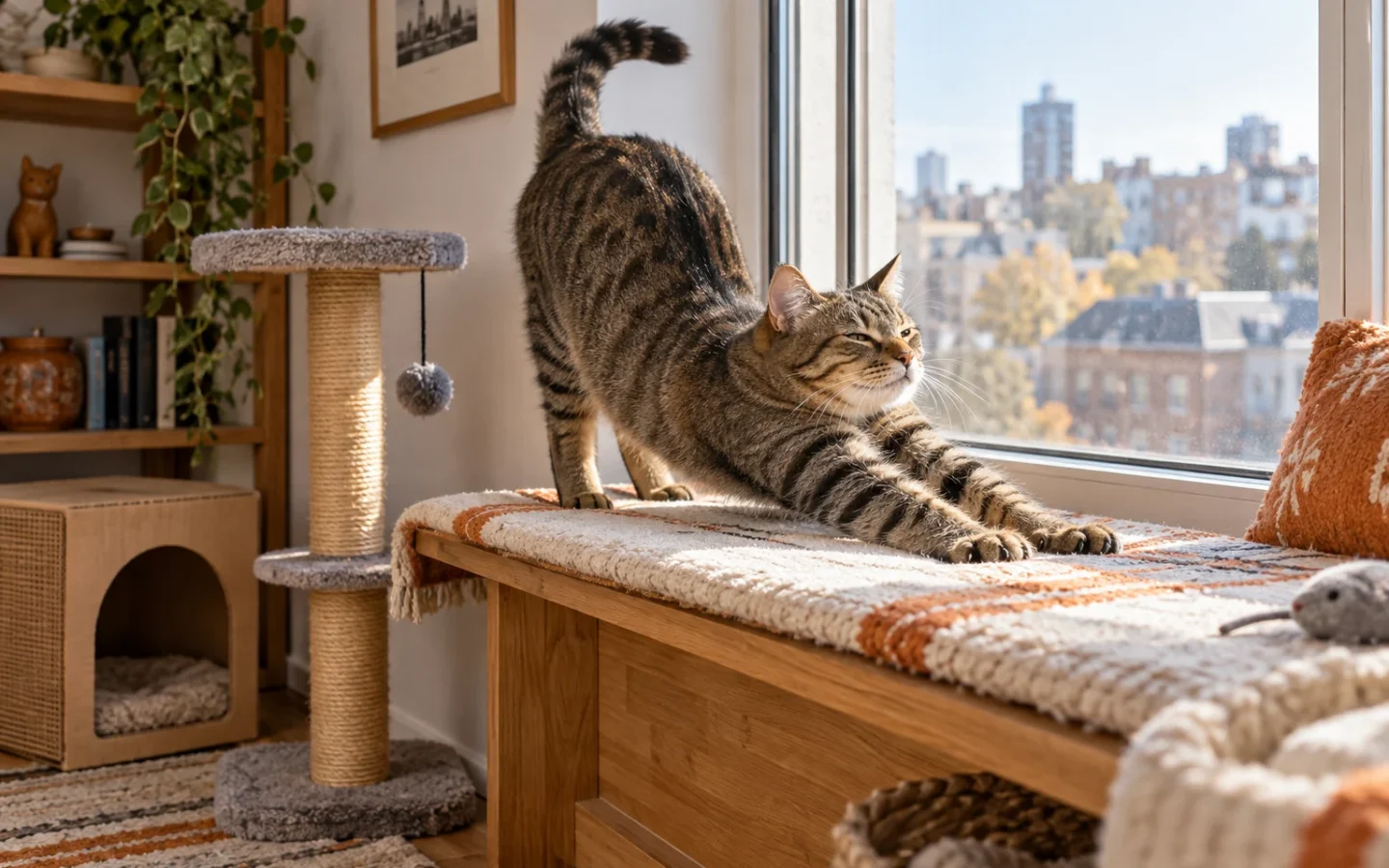
When a cat ignores a new toy, the next useful step may be to observe the room rather than buy a different toy. Can the cat reach the places they need? Where do they rest, watch, hide and move between resources?
The guidance starts with the environment
The Feline Veterinary Medical Association’s 2025 indoor-cat position statement emphasizes meeting cats’ physical, emotional and cognitive needs, with extra attention to individual needs in multi-cat homes. It refers to the five pillars of a healthy feline environment. Read the FelineVMA statement.
The association’s 2026 environmental-needs brochure is a useful caregiver resource. The practical implication for a household is to assess access and choice, rather than treating enrichment as a list of objects to own.
Sketch one room
On a piece of paper, mark food, water, litter, resting places, scratching surfaces and exits. Then draw the route the cat actually takes. Add a question mark where you have not watched the route. A bowl may be present on the map but difficult to approach when another animal waits in the doorway.
Observe each cat separately in a shared home. Note the time and situation: “rested on the shelf while the room was quiet” is more useful than “likes high places” if activity in the room changes the behaviour.
Change one thing you can maintain
Choose one issue you observed. You might make a familiar retreat easier to reach, improve access around a resource or offer a supervised play opportunity in a quieter location. Keep a suitable familiar option available while observing a new setup. Avoid forcing the cat to use the item to demonstrate that it works.
| Write down | Example of a useful record |
|---|---|
| Situation | Evening, dog in another room |
| Change | Offered familiar play item in quieter area |
| Response | Approached, watched, engaged briefly, then left |
| Next step | Repeat under similar conditions and compare |
Review what happened
After several observations, ask whether the change helped and whether the household can sustain it. “Not observed” is a valid entry. A small household record does not prove cause and effect, and a change in eating, toileting, mobility or behaviour may need veterinary assessment rather than more environmental experiments.
The Indoor Cat Home & Enrichment PDF includes a room map, individual profiles, a seven-day record and a purchase worksheet. Start with the free sample to see whether the format suits you.
Sources checked September 25, 2026. PawKnow’s room-map method is an editorial planning exercise, not a clinical assessment. Cover image is AI-generated and illustrative; verify the suitability of actual plants, fittings and play items in your own home.
A bowl on the map is not the same as access
Imagine two cats in a shared home. A water bowl is available, but one cat often rests in the doorway leading to it. The second cat approaches, pauses and turns away. That single observation does not prove bullying, thirst or illness. It gives you a specific question: can this cat reach a suitable water source without passing that doorway?
Mark the observation on the room sketch and note the time, people and animals present. Following the environmental guidance on separated resources, consider an additional suitable water location with a clear route while keeping the familiar option. Observe each cat’s use without carrying them to the new bowl or blocking alternatives. This is an illustrative planning example, not a universal floor plan.
Use a short record before making another purchase
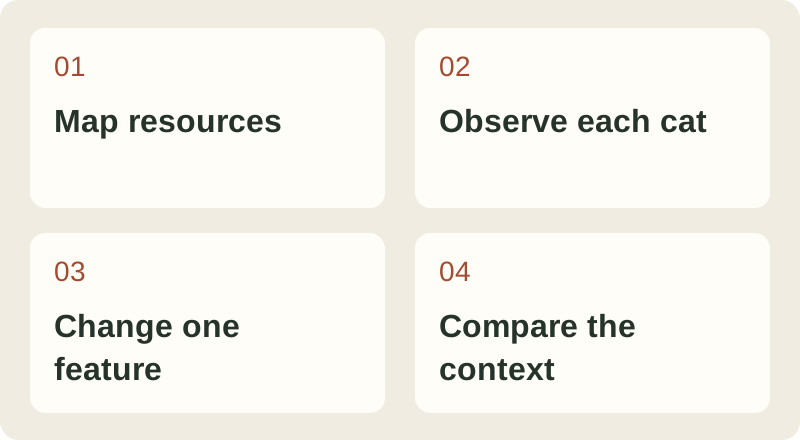
- Map what exists. Mark food, water, toileting, scratching, resting places and routes. Include doors that are sometimes closed.
- Observe each cat. Write what you saw: approached, waited, used, left, or not observed. Avoid replacing observations with labels such as “stubborn.”
- Change one manageable feature. Write what changed and keep appropriate familiar options available.
- Compare similar situations. Record whether the room was quiet or busy and which animals were present. Different conditions can explain different use.
Three brief observations can help you write a clearer question, but they do not establish a treatment effect. New or persistent changes in eating, toileting or mobility need veterinary advice rather than endless rearranging. Resource planning complements care; it does not diagnose a behaviour problem.
Download the free room-observation sheet (English + 中文, 2-page printable PDF). It includes sketch space and a before/after observation record. If you need a longer planning format, the Indoor Cat Home handbook has a free sample to preview before buying. The worksheet and the handbook are PawKnow’s own materials.
Examples, source links and current tool descriptions reviewed September 30, 2026. Existing worksheets and illustrations prepared September 15, 2026.