My first dog, a Golden Retriever named Bailey, lived to 14. Her last three years were a gradual negotiation with time. The stairs became impossible. She’d stand in the kitchen, confused about why she’d come in. She’d pace at night, disoriented. But with the right interventions—pain management, environmental modifications, and dietary adjustments—she had good days until the end. Senior pet care is not about preventing aging. It’s about managing it compassionately and scientifically. Here’s what the research tells us about caring for aging companion animals.
The Biology of Canine and Feline Aging
Senior status begins at different ages depending on size. Small dogs (under 20 pounds) are considered senior at 10-11 years. Large dogs (over 50 pounds) are senior at 7-8 years. Cats are generally considered senior at 11-12 years. The aging process involves cellular senescence, mitochondrial dysfunction, reduced stem cell activity, and chronic low-grade inflammation called “inflammaging.”
A 2023 study in the journal Aging Cell identified that the rate of biological aging in dogs is approximately 7 dog years per human year for the first two years, then 4-5 dog years per human year thereafter. But this varies by breed. Great Danes age biologically at roughly twice the rate of Chihuahuas. This explains why breed-specific geriatric care is essential.
Arthritis: The Silent Disability
Osteoarthritis affects an estimated 80% of dogs over age 8 and 90% of cats over age 12. The prevalence is higher than most owners realize because cats are masters at hiding pain. A cat that sleeps more, avoids jumping, or stops grooming its hindquarters may have significant arthritis. A dog that is “slow to get up” or “doesn’t want to walk as far” is almost certainly arthritic.
Management is multimodal. Non-steroidal anti-inflammatory drugs (NSAIDs) like carprofen and meloxicam are the cornerstone of pain management, but they must be used with caution in senior pets due to kidney and liver risks. A 2024 study found that gabapentin, an anti-seizure medication that also blocks neuropathic pain, provided significant additional relief when combined with NSAIDs in dogs with moderate to severe arthritis.
Joint supplements are widely used but vary in quality. The Arthritis Foundation’s veterinary advisory panel recommends glucosamine sulfate (not glucosamine HCl) at 20 mg/kg/day and chondroitin sulfate at 15 mg/kg/day. Omega-3 fatty acids (EPA and DHA) at 50-100 mg/kg/day have demonstrated anti-inflammatory effects. These are not miracle cures, but they provide incremental benefit when used consistently.
Cognitive Dysfunction Syndrome: The Pet Version of Dementia
Cognitive Dysfunction Syndrome (CDS) in dogs and cats is analogous to Alzheimer’s disease in humans. The prevalence is striking: by age 15, 60% of dogs show at least one clinical sign of CDS. The condition is underdiagnosed because owners attribute behavioral changes to “normal aging.”
The DISHA acronym describes the core symptoms: Disorientation (getting lost in familiar places), Interactions (changes in social behavior with family members), Sleep (restlessness at night, sleeping during the day), House-training (accidents despite previously reliable habits), and Activity (reduced interest in play and exercise). A dog showing two or more of these signs warrants veterinary evaluation.
Treatment is challenging but not hopeless. Selegiline (Anipryl) is the only FDA-approved drug for canine CDS. It works by increasing dopamine levels in the brain. A 2023 study found that selegiline improved behavioral scores in 70% of treated dogs within 4-6 weeks. Dietary supplements containing phosphatidylserine, antioxidants, and medium-chain triglycerides (MCTs) have also shown some promise. Environmental enrichment—new toys, puzzle feeders, and regular gentle exercise—helps maintain cognitive function.
Environmental Modifications for Senior Pets
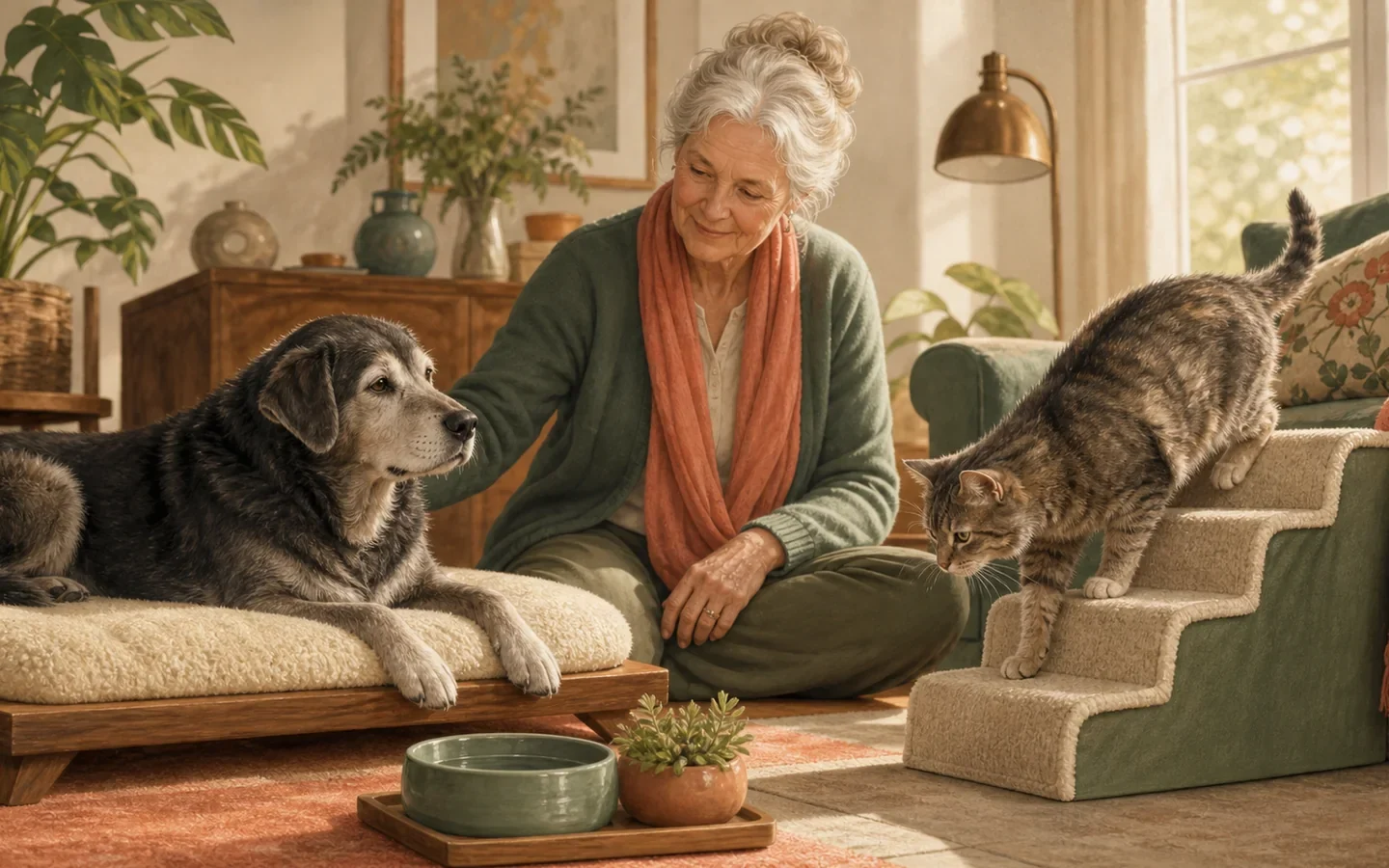
Small changes in the home environment can dramatically improve quality of life. Non-slip flooring (yoga mats, rubber-backed rugs) prevent falls. Ramps or pet stairs reduce the need to jump. Raised food and water bowls reduce neck strain. Nightlights help pets with diminished vision navigate in the dark. Heated beds provide warmth for arthritic joints. These modifications cost little but make a measurable difference.
Key Takeaways
- 80% of dogs over 8 and 90% of cats over 12 have osteoarthritis—often undiagnosed
- 60% of dogs over 15 show signs of Cognitive Dysfunction Syndrome (CDS)
- Multimodal arthritis management includes NSAIDs, gabapentin, joint supplements, and environmental modifications
- Selegiline is the only FDA-approved drug for CDS and improves symptoms in 70% of dogs
- Non-slip flooring, ramps, nightlights, and heated beds are low-cost, high-impact environmental modifications
2026 evidence update: aging changes the examination, not the animal’s value
AAHA’s senior-care guidelines emphasize that old age is not a disease. Senior appointments should assess mobility, pain, cognition, nutrition, oral health, sensory change and organ function, with diagnostics based on the individual. Small changes in sleep, stairs, grooming, house soiling or social behavior can be early medical signals.
Quality of life is best followed as a trend: comfort, appetite, hydration, hygiene, mobility, social engagement and favorite activities. Palliative and hospice care should be discussed before a crisis.
Start the conversation
Share an experience or a useful question. Please keep medical emergencies for your veterinarian.