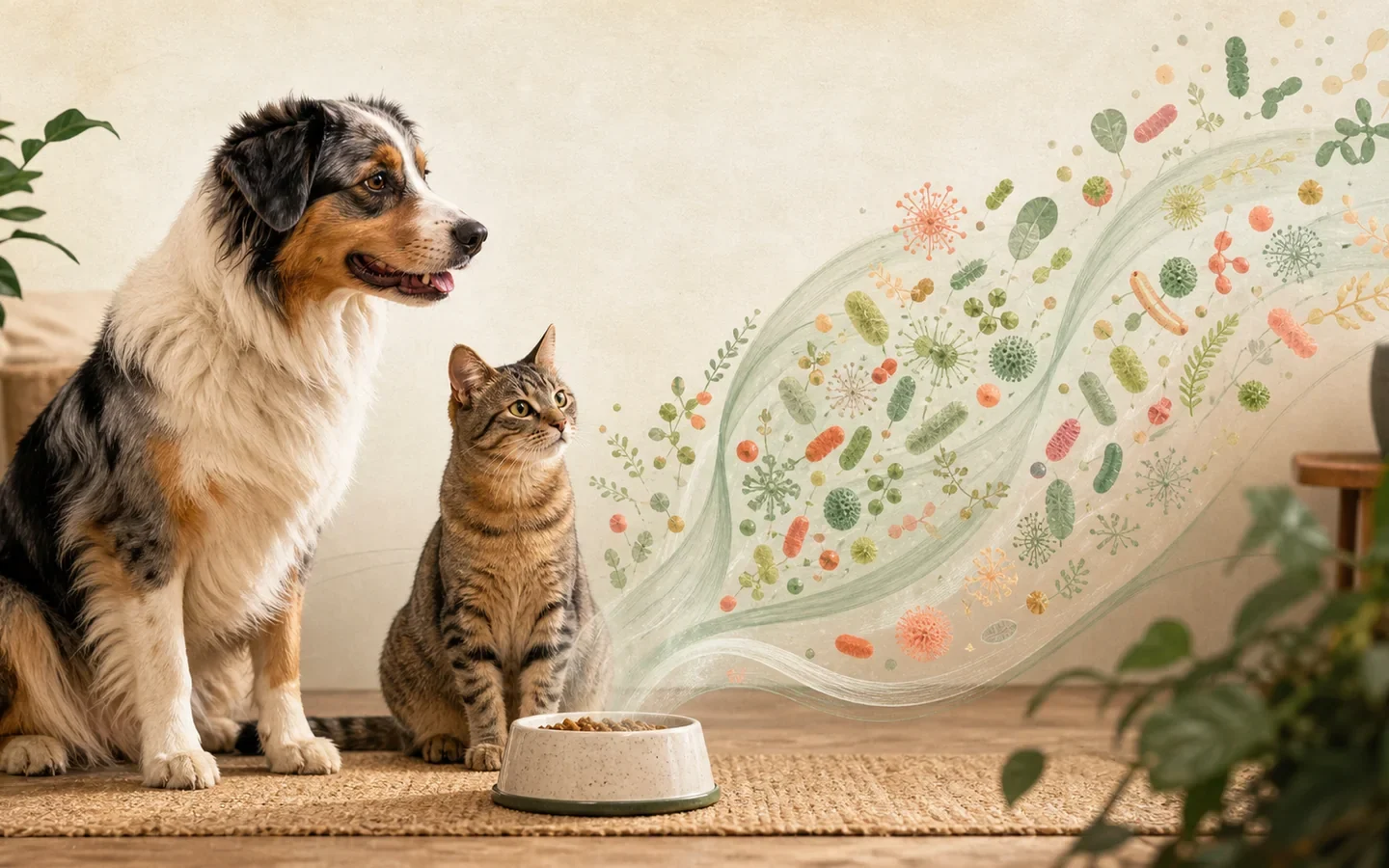
About five years ago, Dr. Jan Suchodolski at Texas A&M University’s Gastrointestinal Laboratory published a paper that quietly revolutionized how veterinarians think about canine health. It wasn’t about a new drug or surgical technique. It was about the trillions of bacteria living in dogs’ intestines. The canine gut microbiome, it turns out, influences everything from digestion to immune function to behavior. And we’re only beginning to understand how to manipulate it.
What Is the Gut Microbiome?
The gut microbiome is the collection of bacteria, fungi, and viruses that colonize the gastrointestinal tract. In dogs, this community consists of approximately 1,000 different bacterial species. The most abundant phyla are Firmicutes and Bacteroidetes, which together make up about 90% of the total bacterial population. But the specific composition varies dramatically between individual dogs—more than between individual humans.
What makes the microbiome interesting isn’t just its diversity, but its functional capacity. These bacteria produce short-chain fatty acids (SCFAs) like butyrate, acetate, and propionate, which provide 60-70% of the energy used by intestinal cells. They synthesize vitamins, regulate immune responses, and produce neurotransmitters like serotonin and GABA that affect mood and behavior. A 2023 study in Nature Microbiology found that gut bacteria can influence anxiety-related behavior in dogs through the gut-brain axis.
Probiotics: What the Evidence Actually Says
Probiotics are live microorganisms that, when administered in adequate amounts, confer a health benefit. The most common canine probiotic strains are Lactobacillus acidophilus, Lactobacillus reuteri, Bifidobacterium animalis, and Enterococcus faecium. But here’s the critical nuance: not all probiotics are equal, and the evidence is mixed.
A 2024 meta-analysis published in the Journal of Veterinary Internal Medicine reviewed 47 randomized controlled trials of probiotics in dogs. The results were cautiously positive. Probiotics showed statistically significant benefits for acute diarrhea (reducing duration by an average of 1.2 days), antibiotic-associated diarrhea (reducing incidence by 34%), and chronic enteropathies in some cases. However, for healthy dogs with no digestive issues, the benefits were minimal or non-existent.
The strain specificity matters enormously. A study at the University of Liverpool found that Lactobacillus rhamnosus GG reduced stress-related diarrhea in working dogs by 40%, while a generic mixed-strain probiotic had no significant effect. This means the label “contains probiotics” is essentially meaningless without knowing the specific strains, doses, and CFU counts.
Prebiotics: The Forgotten Half
Prebiotics are non-digestible food components that selectively stimulate the growth of beneficial bacteria. Common prebiotics in pet food include fructooligosaccharides (FOS), galactooligosaccharides (GOS), and inulin. Unlike probiotics, which introduce new bacteria, prebiotics feed the bacteria that are already there.
A 2023 study by the Waltham Petcare Science Institute found that dogs fed a diet containing 0.5% FOS showed a 15% increase in Bifidobacterium species and a corresponding increase in SCFA production after 28 days. The dogs also showed improved stool quality scores. The effect was dose-dependent—higher concentrations (up to 1%) produced greater benefits, but concentrations above 1.5% caused flatulence and soft stools in some dogs.
Key Takeaways
- The canine gut microbiome contains ~1,000 bacterial species and influences digestion, immunity, and behavior
- Probiotics reduce acute diarrhea duration by ~1.2 days and antibiotic-associated diarrhea by 34%
- Strain specificity matters—generic “probiotic” labels are meaningless without strain details
- Prebiotics like FOS at 0.5-1% increase beneficial bacteria and improve stool quality
- Healthy dogs without digestive issues show minimal benefit from probiotic supplementation
2026 evidence update: “probiotic” is not one intervention
Reviews of canine microbiome research find plausible and sometimes useful effects from specific probiotics, prebiotics and synbiotics, but results depend on strain, dose, diet, disease and outcome. A label listing only a bacterial species or a large CFU number does not prove clinical benefit.
Microbiome sequencing is valuable in research, but consumer stool reports do not yet define one ideal community or replace a veterinary workup for chronic diarrhea, weight loss, vomiting or blood.
Sources
How to read a microbiome claim
A change in microbial abundance is not automatically a health benefit. Stronger evidence connects a defined strain or substrate, dose and duration to a clinically meaningful outcome in the target species. Studies using healthy laboratory animals, a different disease or a proprietary mixture do not necessarily predict the result for an individual pet.
For probiotics, record the strain designation, viable count through the end of shelf life, storage conditions and the symptom being monitored. For prebiotics and fiber, introduce changes gradually because fermentation can alter stool and gas. If diarrhea is persistent, bloody, accompanied by vomiting or weight loss, diagnostic care is more important than trying additional supplements.
Start the conversation
Share an experience or a useful question. Please keep medical emergencies for your veterinarian.