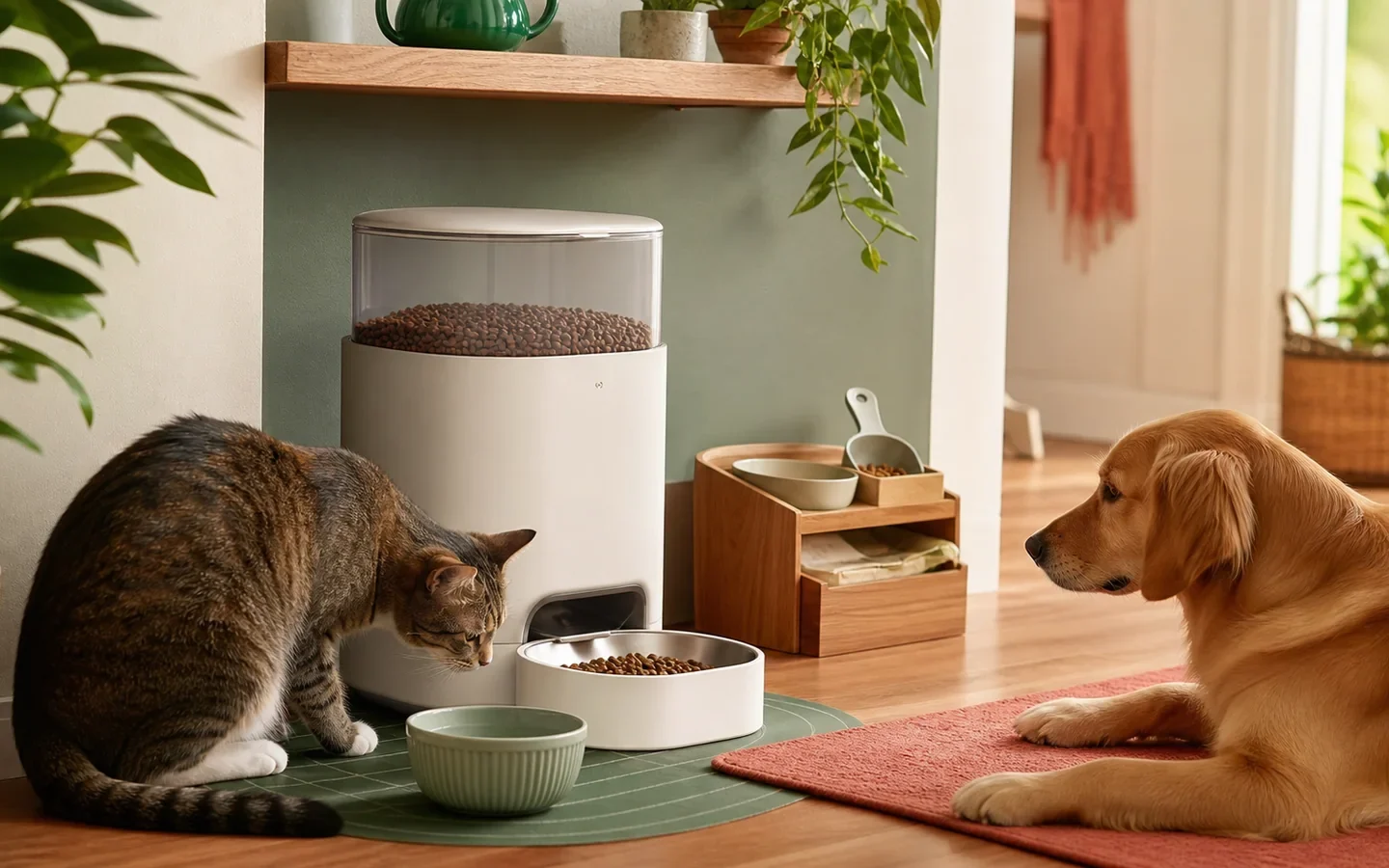
An automatic feeder solves one narrow problem very well: delivering measured meals on a schedule when a person cannot be beside the bowl. It does not confirm that the intended pet ate the meal, replace a sitter during travel, or turn an unsuitable diet into an appropriate one. The most useful buying decision therefore starts with the food format, the number of pets, and the consequence of a missed or oversized portion—not with the number of app features.
Our short list
Best automated wet-food option: PETLIBRO Polar Wet Food Feeder
Best high-capacity, schedule-first option: Whisker Feeder-Robot
| Model | Food | Why it stands out | Main limitation |
|---|---|---|---|
| PETLIBRO Granary Smart Camera | Dry kibble | 5 L hopper, camera, app scheduling, local microSD option on the camera model | Volumetric portions still vary with kibble shape; a camera cannot stop food theft |
| PETLIBRO Polar | Wet food | Active thermoelectric cooling and three scheduled compartments | Small total capacity; hygiene depends on prompt cleaning and reliable power |
| Whisker Feeder-Robot | Dry kibble | Up to 32 cups, schedules remain on the device, app or keypad control | Large and expensive; no camera or individual-pet access |
1. PETLIBRO Granary Smart Camera: the most complete dry-food package
PETLIBRO documents a 5-liter hopper for the Granary camera model, with scheduled dispensing, dual-band Wi-Fi on the camera version, two-way audio, and a 1080p camera. Independent 2026 testing by WIRED praised the Granary family for its accessible app and connected experience. A separate month-long review by Tom’s Guide found the overhead camera genuinely useful for confirming which cat approached the bowl and noted that the microSD slot can reduce dependence on cloud recording.
The important caveat is portion measurement. Like most affordable feeders, the Granary meters food by volume rather than weighing every serving. Pellet diameter, density, oiliness, and broken pieces change the grams delivered by a nominal “portion.” Before relying on any automatic feeder, dispense at least ten portions into a kitchen scale, calculate the average in grams, and repeat the check whenever the food changes. For a pet on a strict weight-loss or therapeutic plan, that calibration matters more than the camera.
Best for: one pet eating dry kibble, owners who want visual confirmation, and homes that value app scheduling. Skip it when: one animal steals another’s prescription food, the pet eats wet food, or a medically important dose must be delivered with near-clinical precision.
2. PETLIBRO Polar: the strongest mainstream wet-food solution
The Polar uses thermoelectric cooling rather than a passive ice pack. PETLIBRO says its three compartments can keep scheduled wet meals chilled for up to three days; TIME highlighted the product’s active cooling design when it launched. That makes it materially different from rotating tray feeders whose ice packs gradually warm over several hours.
Manufacturer duration is not a guarantee under every room temperature, fill level, or power condition. Treat the feeder as a small food appliance: pre-chill the food, keep the tray clean, do not repeatedly add fresh food on top of residue, and discard anything that smells or looks abnormal. The CDC’s pet-food safety guidance remains relevant—wash hands and bowls, refrigerate opened wet food promptly, and avoid allowing residue to sit at room temperature.
Best for: cats that rely on wet food and need several scheduled meals. Skip it when: outages are common, the cat must be observed taking medication, or nobody can check the unit for multiple days.
3. Whisker Feeder-Robot: large capacity and resilient scheduling
Whisker lists a dry-food capacity of up to 32 cups. Schedules can be programmed from the keypad or app, and the company says a downloaded schedule continues even if the network goes offline. That is a meaningful reliability advantage: feeding should not fail merely because a router reboots. The modular hopper and dispenser are also easier to reason about than products that combine cameras, facial recognition, and several cloud services.
The trade-off is value. It costs substantially more than basic timed feeders while lacking a camera or selective-access gate. Large capacity can also create false confidence; kibble can become stale, a chute can jam, and a pet can vomit or refuse food while the hopper still appears full. Capacity is convenience, not supervision.
Best for: larger dry-food households, owners already using Whisker products, and people who prioritize offline schedules. Skip it when: space is tight, the pet needs wet food, or a smaller calibrated feeder already meets the need.
What we would not trust without verification
- “AI nutrition” claims: unless the feeder actually weighs food and has validated recognition, the phrase usually describes an app summary rather than medical-grade measurement.
- Split bowls for two pets: a splitter divides one dispense; it does not guarantee equal portions or prevent the faster animal from eating both sides.
- Cloud-only controls: confirm that schedules survive a Wi-Fi outage and that meals can be programmed on the device.
- Wet food left unattended for days: active cooling reduces risk but does not eliminate cleaning, power, and spoilage failure modes.
A practical setup test
- Run the feeder beside the existing bowl for three days before depending on it.
- Weigh ten dispenses and record the gram range, not just the average.
- Disconnect Wi-Fi and briefly disconnect mains power to confirm the saved schedule and backup behavior.
- Watch one complete cycle to check for food theft, startle responses, or whisker discomfort.
- Wash food-contact parts on the manufacturer’s schedule and inspect the chute for oily residue.
Final verdict
The Granary Smart Camera is the most balanced choice for ordinary dry-food households because it combines scheduling with useful visual confirmation. The Polar is the category-changing option for wet food, provided the owner treats it like a refrigerated appliance rather than a magic bowl. The Feeder-Robot is compelling when hopper size and offline scheduling justify the price. None should be the only safeguard for a diabetic pet, a pet receiving medication, or an animal that needs close appetite monitoring.
Start the conversation
Share an experience or a useful question. Please keep medical emergencies for your veterinarian.